Not a dashboard. A research specialist for the local-search problems that need one.
A purpose-built AI research agent that investigates local search visibility issues on demand — isolated client context, current web research, and evidence organized into a documented, policy-aligned case.
Private Deployment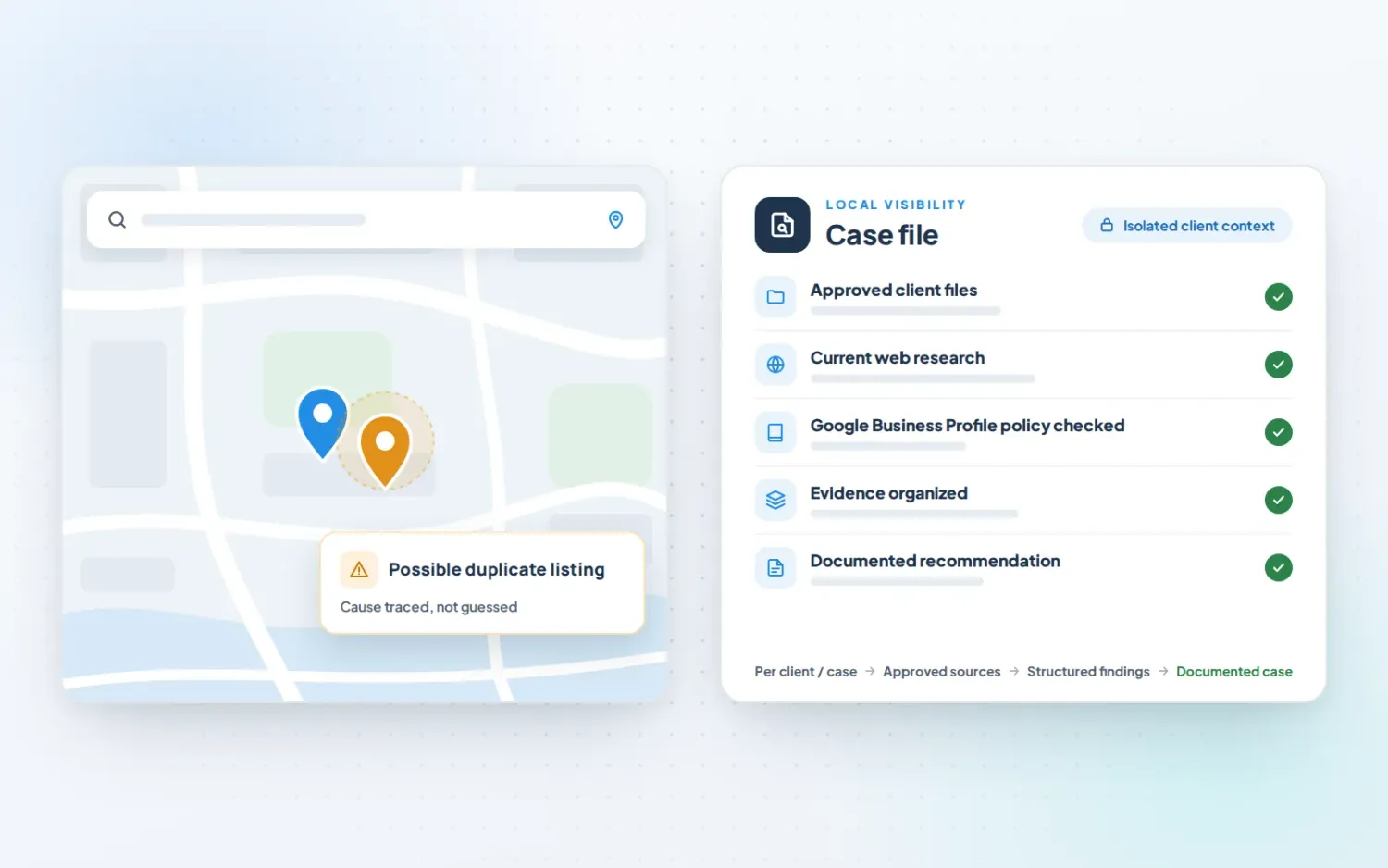
The Challenge
Some visibility problems need investigation, not a checklist.
A local listing losing visibility is rarely one simple fix — it's often a duplicate profile, an ownership conflict, or a Google Business Profile policy issue that needs real research to diagnose. That kind of investigation doesn't fit a recurring audit template; it needs an agent that can dig into one case at a time.
How It Works
On-demand, not always-on.
Given a case, the agent works inside an isolated client context, pulling in approved files and current web research — including Google's own published policy guidance — to investigate duplicate listings or ownership conflicts, then organizes what it finds into evidence and a documented recommendation.
Key Capabilities
What it actually does
Isolated client context
Each case runs in its own scoped context — no cross-client bleed.
Google Business Profile policy research
Checks findings against Google's current published guidance, not cached assumptions.
Duplicate / ownership investigation
Traces the specific cause of a visibility issue rather than guessing.
Case documentation
Produces a written, evidence-backed record of findings and recommendations.
After hardening, the agent kept only the file and web access its research work needs — terminal access, browser automation, code execution, delegation to other agents, and autonomous scheduling were all removed. It was validated by reading an existing case brief, identifying the underlying issue, researching current Google guidance, and producing policy-aligned recommendations.
Results / Outcome
What changed
Visibility issues that used to require piecing together research by hand now get a structured, documented case — on demand, scoped to the client, and checked against current Google policy rather than outdated rules of thumb.