A private command layer for the parts of the day no one has time to triage.
The AI Executive Operations Assistant connects email, four calendars, Notion, and lead review into one restricted operations layer — reading and drafting continuously, acting only when a human explicitly authorizes it.
Private Deployment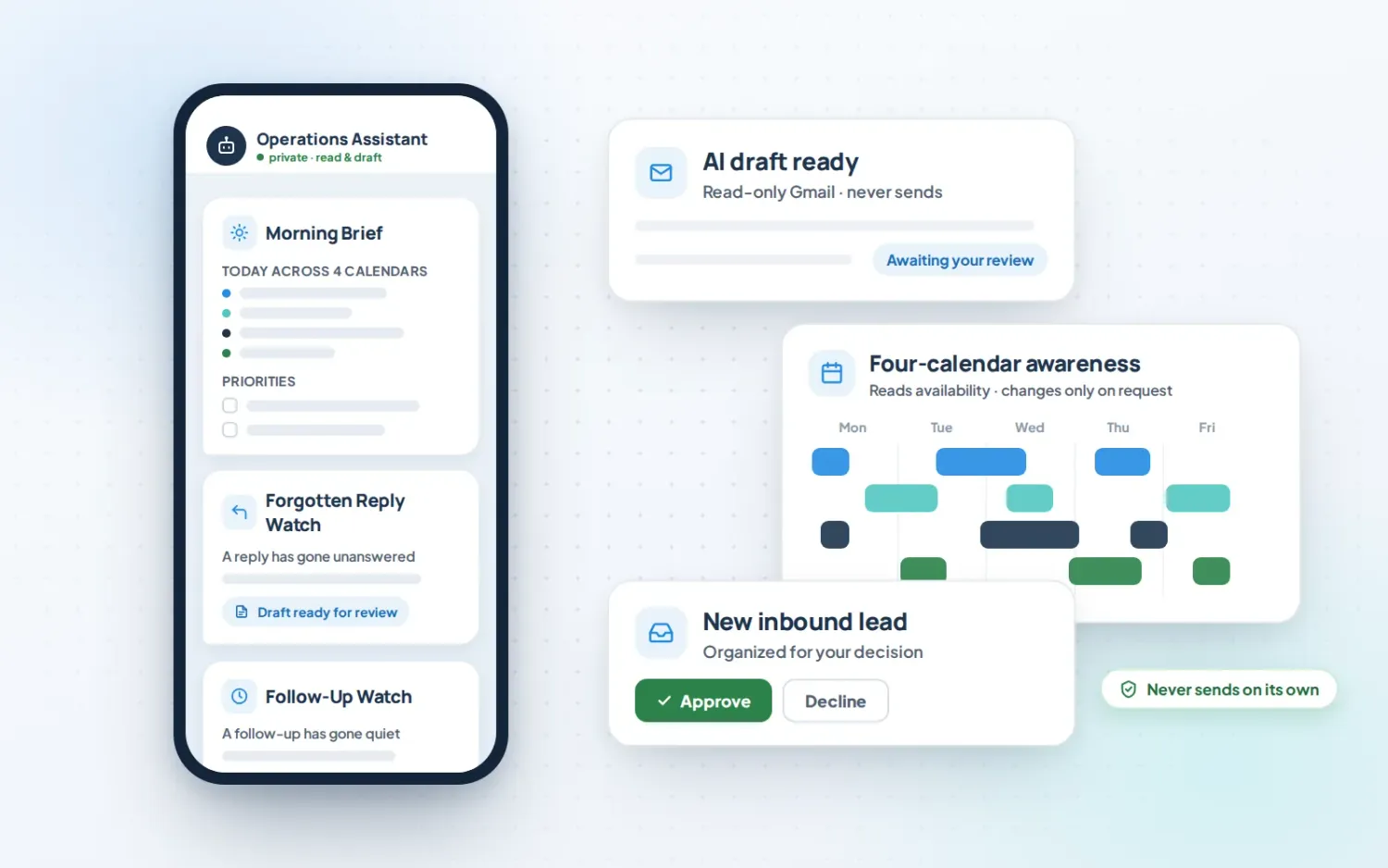
The Challenge
Four calendars, one inbox, and no time to triage either.
Daily operations were scattered across multiple email identities, four separate calendars, a Notion workspace, and an inbound lead flow — each demanding attention on its own schedule. Nothing was individually complex; the cost was in the constant context-switching required to stay on top of all of it manually.
How It Works
Three lanes, one rule: nothing consequential happens without sign-off.
(Read Only)
Human Review
Explicit Request Only
Authorization
Morning Brief · Forgotten Reply · Follow-Up
(tasks / follow-ups)
Authorization
Notion Update · Lead Approval/Decline
Key Capabilities
What it actually does
Read-only Gmail intelligence
Continuously understands inbox context across approved accounts — never sends, archives, deletes, labels, or forwards.
Message-level identity routing
Recognizes which brand or identity a message belongs to and handles it in that context.
Four-calendar awareness
Reads availability across all four; changes to any calendar require an explicit request.
Notion operations
Creates and updates tasks, projects, and follow-ups on approval.
Scheduled intelligence
Morning Brief, Forgotten Reply Watch, and Follow-Up Watch run on a schedule and deliver to Telegram.
Controlled lead review
Surfaces and organizes inbound leads for a human decision — never approves one itself.
Tech Stack
Built on
Results / Outcome
What changed
Inbox and calendar context that used to require active checking now arrives pre-organized — a Morning Brief, a flagged forgotten reply, a follow-up that's gone quiet — instead of being found by accident. Nothing sends or changes a calendar without a human decision, so the system adds coverage without adding risk.
"The goal was never a fully autonomous inbox. It was an assistant that never has to be trusted with 'send' — because it never needs that power to be useful."