AI capability does not require unlimited access.
The Secure Multi-Agent AI Operations System is a private architecture connecting specialized AI agents to approved business systems through a restricted permissions layer — with human authority as the final checkpoint on every consequential action.
Private Deployment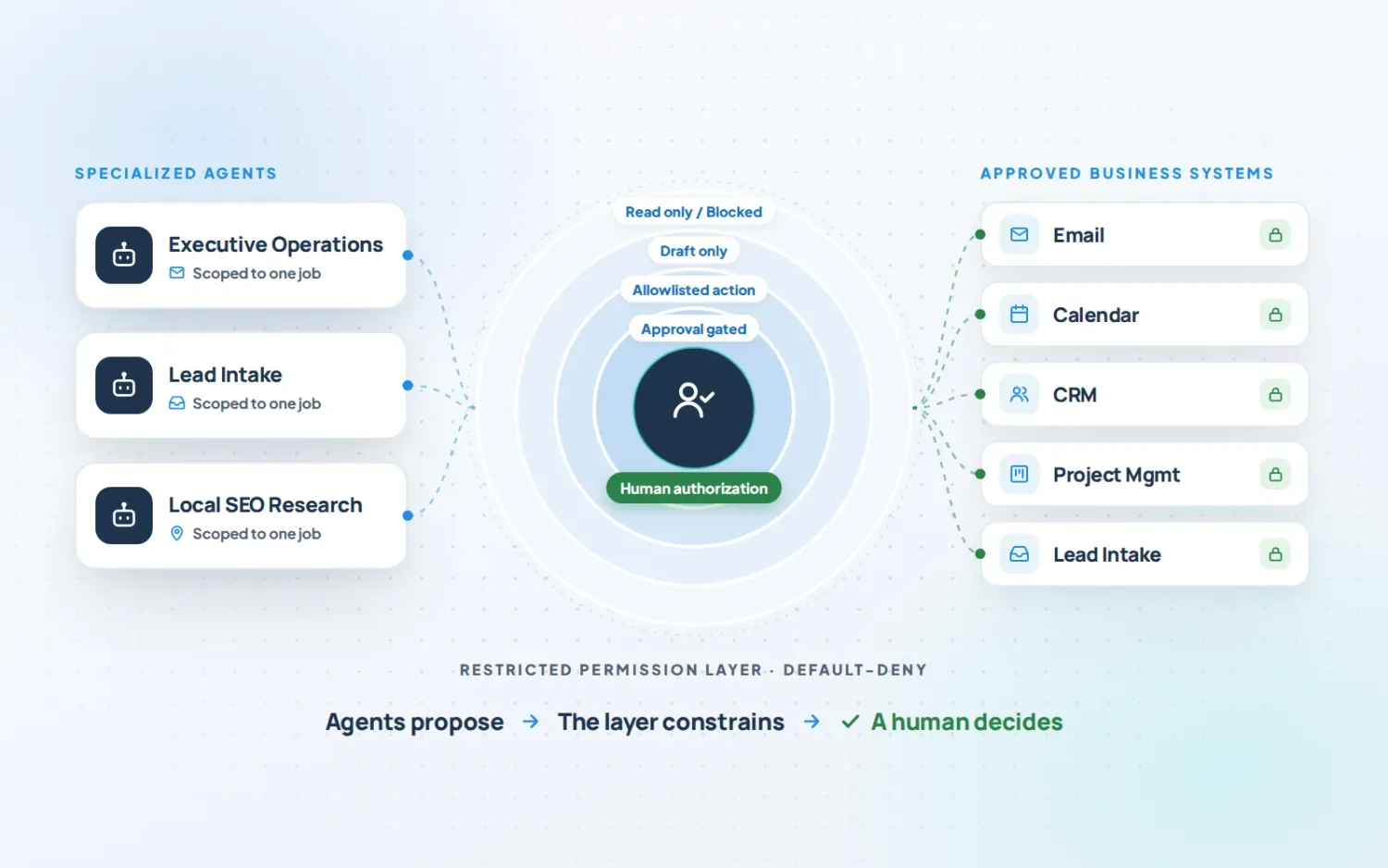
The Challenge
Real AI leverage, without a blank check on access.
Most "AI automation" setups solve for convenience by granting broad access: full inbox control, unrestricted calendar write access, standing API keys with no expiry. That trade works until something goes wrong — and then it's not clear what the AI actually could have done, because nothing constrained it beyond good intentions.
The brief here was different: build AI agents capable of real operational work — reading, drafting, researching, organizing — without ever giving any single agent unilateral authority over a business system. Capability and access needed to be separated by design, not by policy.
Architecture · 01
Overall architecture
Every agent in the collection below sits behind the same restricted layer before it ever touches a real system.
Agents
MCP Layer
Authority
How It Works
Agents propose. The layer constrains. A human decides.
Each specialized agent (executive operations, lead intake, local SEO research, and others in this collection) is scoped to one job. None of them talk to a business system directly — every request passes through a restricted MCP layer that knows exactly what that agent is allowed to read, draft, or act on, and rejects anything outside that scope before it ever reaches Email, Calendar, CRM, or any other connected system.
Anything consequential — sending, deleting, approving, or committing to an external party — stops at a human-authorization checkpoint. The agents do the reading, researching, and drafting; a person makes the call on anything that leaves the building.
Key Capabilities
What the architecture enables
Scoped agent permissions
Every agent's access is defined per system, per action — not "AI access," but a specific, auditable allowlist.
Human authorization checkpoints
Consequential actions pause for explicit approval instead of executing automatically.
Sandboxed execution
Agent processes run inside restricted, isolated environments — not general-purpose shell access.
Composable across systems
The same permission layer governs every connected business system, so adding a new agent doesn't mean widening access elsewhere.
Architecture · 02
Permission model
Access narrows the closer an action gets to a real system — nothing reaches the protected core without passing through every ring.
Business Systems
Security & Control Architecture
Default-deny, not default-trust.
Every agent starts at the outermost ring: read-only, or blocked outright. Capability is granted ring by ring, not system by system — an agent that can draft a Notion update doesn't automatically gain any calendar or CRM access, because each permission tier is evaluated independently per action, not inherited.
The innermost ring, Human Authorization, is not a formality: it's the only path to anything that changes a real business system in a way that can't be quietly undone.
Tech Stack
Built on
Connected business systems across the collection include Gmail, Google Calendar, Notion, Systeme.io, Zapier, 17hats, and Telegram — each reachable only through the restricted layer above, with no standing credentials exposed to any agent directly.
Results / Outcome
What changed
Operational work that used to require either full manual handling or an uncomfortable amount of standing AI access now runs through agents that can do the reading, drafting, and organizing — with nothing consequential happening until a person signs off. The permission model scales: adding the next specialized agent to this collection means defining its ring, not re-auditing everyone else's access.
"The interesting design problem was never 'can AI do this work.' It was 'how much can we let it do without ever having to fully trust it.' The permission layer is the answer — capability and authority, kept separate on purpose."
Related Systems
Have a system like this in mind?
Let's talk about what a private, permission-scoped AI architecture could look like for your operation.
Start Your Project